What’s Ahead:
- While the bear market could have reached a bottom in October, volatility persists.
- The Federal Reserve (Fed) is likely to push rates up even more if inflation is not going away fast enough in traders’ eyes.
- Buffered ETFs are a possible solution to combat positive stock/bond correlations amid an ongoing S&P 500 trading range.
Investors have had a moment to gather themselves after a rough 2022. The S&P 500 fell nearly 20% last year while the bond market suffered its worst annual performance since the U.S. Aggregate Bond Index was created in 1976. The result was a dreadful total return on the classic 60/40 allocation, made even worse by four-decade-high inflation. “Real” returns were the worst endured since 2008 for investors with balanced allocations between equities and fixed income.
Inflation Spooks Stocks Once More
Now here we are in early 2023 with the S&P 500 solidly above its October low while interest rates initially dipped to jumpstart the new year. But the inflation boogeyman is not so easy to tame. Hot jobs data and troublesome inflation readings during February for the previous month sent yields climbing. Short-term yields jumped to their highest readings since the mid-2000s while global bond markets have seen similar selling pressure.
Concerning bearish price action in fixed income has been a headwind for stocks. Many pundits suggest a trading range has developed on the S&P 500 with a base in the mid-3000s and a cap near 4200. Call it a roughly 20% zone which frustrates the bulls and bears alike. What’s more, long-term investors might feel uneasy now that we have not seen new highs in domestic markets for more than a year.
Buffered ETFs: A Tactical Strategy
There’s a way to play this possible new range, however. Buffered ETFs could be just the solution to today’s sideways price action. Here’s why: Buffered ETFs, also known as defined-outcome funds, offer holders a downside protection level along with an upside cap.
Think of it this way: If the market indeed rallies to the top end of the trading range, then a buffered ETF that is capped near, say, 4200 on the S&P 500 would align well with the market’s range. Then on the downside, a 10% buffer off a hypothetical 4000 would protect against losses down to 3600 on the SPX.
Now could be an ideal time for retail investors to own buffered ETFs should this market environment persist throughout the year.
Buffered ETFs Might Better Fight the Fed, Too
Another thing to consider is that Fed Chairman Jerome Powell may look to stymie potential equity gains if investors get too sanguine in their outlook. One of the measures the Fed uses to gauge financial conditions is indeed the level of stock prices.
One theory posits that when equities advance too sharply, financial conditions turn too easily, forcing the Fed’s hand to tighten. Then when stocks fall too much, those conditions tighten on their own, allowing the Federal Open Market Committee (FOMC) a bit more wiggle room with their policy. So, while it’s said that there’s no “fighting the Fed,” buffered ETFs can actually do the job effectively should this market scenario continue.
Volatility Returning From a Lull?
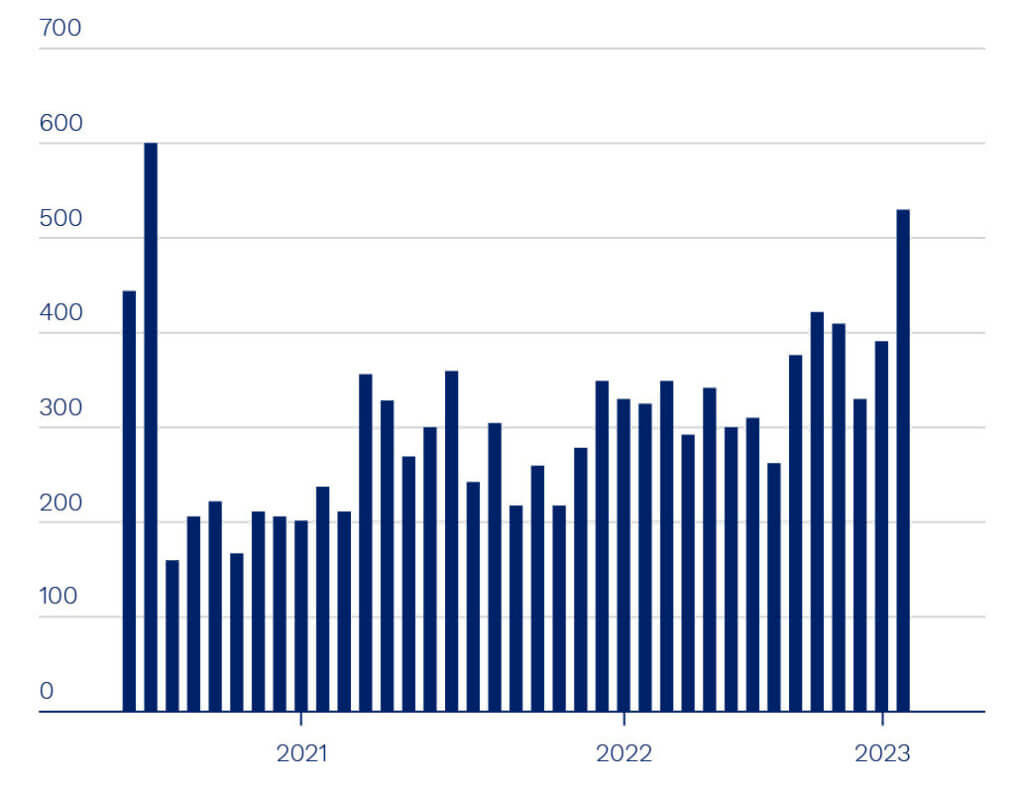
There are other signs that volatility could be on the rise. According to Chicago Board Options Exchange (CBOE) data gathered by The Wall Street Journal, February notched the highest amount of call options on the Volatility Index (VIX) in any month since March 2020—the COVID-induced stock market trough. That means speculators and hedgers alike are placing bets that volatility will rise in the coming months, and that is typically associated with declines in the stock market. Once again, buffered ETFs offer cushion to a possible downside equity market risk.
Traders Wager on High Volatility in 2023
VIX Average Daily Call Options Volume
700 thousand contracts
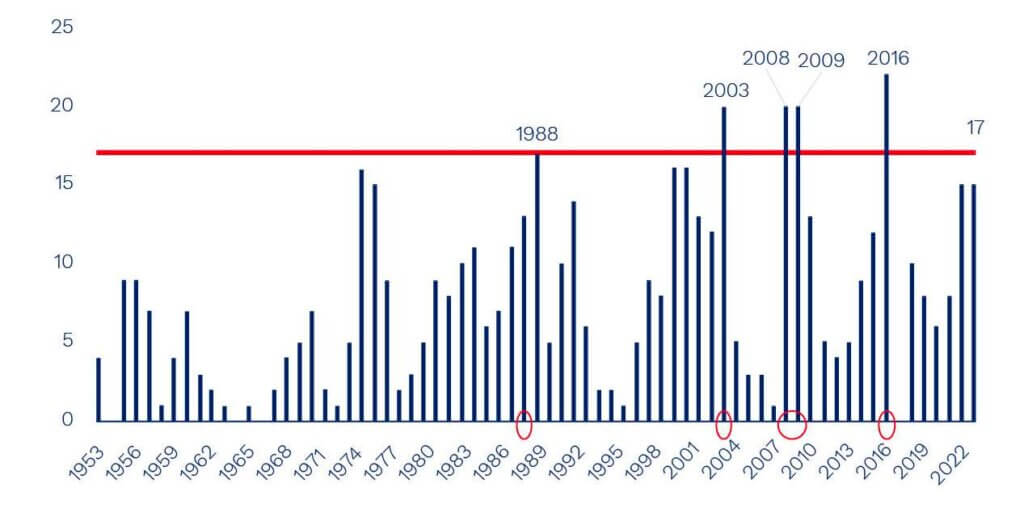
We have already witnessed volatility in 2023. While the VIX has remained tame, baffling some market observers, Bespoke Investment Group notes that through the first 35 trading days of the year, there have been 17 S&P 500 daily changes of 1% or more—the fifth highest level since 1953. While it’s hard to say if this trend will persist (though options traders seem to think it will), it appears 2022’s aura of trepidation has remained with us.
Volatility Remains Elevated This Year
S&P 500 Number of 1% Daily Moves in First 35 Trading Days of the Year
Why Buffered ETFs? Why Now?
Buffered ETFs can help everyday investors endure today’s market. Being able to sleep better at night with a portfolio focused on risk control can lead people to stick with their long-term investing plans better, too.
Buffered ETFs contain four primary components: a maturity date, an underlying asset, a protection amount, and a return/payoff cap. By strategically entering a Buffered ETF with a desired protection amount and upside return cap, an advisor can bring down the overall volatility of a portfolio.
Considering there is usually a 12-month maturity on buffered ETFs, exiting the fund, rolling into a new one, or simply continuing to hold the original ETF offers advisors the chance to take profits, spot better risk/reward opportunities, or just continue with the strategy indefinitely.
We find that buffered ETFs work best via three strategies:
1) Portfolio de-risking
Investors nervous about further downside in stocks can shift part of their equity sleeve into a buffered ETF to help mitigate the risk of more losses. This is especially useful for individuals and couples nearing retirement when the sequence-of-returns risk is greatest. Once the advisor deems the market environment more favorable, along with the client’s situation becoming less precarious, a shift back into traditional funds would be executed.
2) Diversification
Buffered ETFs can also be used to increase overall return by repositioning a balanced allocation from stocks and bonds with a nod toward risk management. For instance, today a portfolio might pull from both asset classes to target an upside level on stocks that is about 10% above the current price. At the same time, a 10% buffer would limit losses. Moreover, with equities and fixed income moving together to an extent that we haven’t seen since the mid 1990s, this type of return outcome has the effective result of dampening an allocation’s overall standard deviation more effectively than a basic 60/40 basket.
3) Putting idle cash to work
Traditional portfolio theory and personal-finance wisdom state that an investor should have no more than three to six months’ worth of expenses in cash. With bond fund NAVs falling due to higher interest rates and the positive stock/bond correlation mentioned before, retail clients might be uneasy putting money to work right now. Buffered ETFs work behaviorally to get investors’ cash invested in a risk-focused way.
The Bottom Line
Now may be an ideal time to consider buffered ETFs for your clients. Whether or not a trading range continues in the market, there are signs that volatility is here to stay as the Fed journeys toward a “higher for longer” interest rate regime.