
What’s Ahead:
- The traditional 60/40 allocation now carries equity-like risk amid higher stock-bond correlations and stretched valuations.
- Structured Notes help redefine portfolio outcomes through downside protection, enhanced participation, and uncorrelated-income generation.
- Halo’s 50/30/20 framework modernizes diversification for today’s volatile, policy-driven market environment.
There is never a bad time to check in on your portfolio, but the turn of the year is a natural season of reflection. With the equity bull market now well into Year 4, risk assets are more richly priced today, while an investor’s allocation may have turned more stock-heavy.
What’s more, new risks have emerged both at the macro level and for individual investors, particularly for those nearing or in retirement. As 2026 gets off and running, let’s evaluate the financial landscape and how advisors and their clients can better shield themselves from volatility that may lie ahead.
A Year Ago… When the Vibes Were Better
To best assess the financial playing field, it helps to go back in time. Just 12 months ago, Wall Street strategists were generally upbeat, calling for an 8%–10% climb in the S&P 500 in 2025. Everything appeared on track, from improved consumer and business sentiment to a strong, stable U.S. dollar to record earnings from the world’s biggest companies.
Now, it’s impossible to discuss markets without invoking political discourse — analysts broadly expected Trump 2.0 to deliver tax relief, deregulation, and perhaps higher tariffs, in that specific order.
When Policy Shock Hit the Market First
Instead, tariffs were first on the agenda. Leading up to the “Liberation Day” announcement from the White House Rose Garden in early April, stocks were sinking, and volatility was spiking. Concern turned to fear, which morphed into outright panic.
The S&P 500 approached a 20% decline from its February 2024 peak to the April nadir. As for bonds, they did not offer the ballast many diversified investors hoped for. Treasuries turned “yippy,” as the president put it. As so often happens, the bond market was the ultimate arbiter of economic policy.
A New Macro Regime Takes Hold
D.C. drama and trade war theatrics aside, investors were reminded that today’s environment is vastly different from five or 10 years ago. Traditional fixed income strategies have not provided the same diversification benefits they once did. Portfolio managers and retail investors alike must accept the new macro regime and put money to work accordingly.
Introducing the Risk Gap
At Halo, we identify the “Risk Gap.” Today, we estimate that the traditional 60/40 portfolio can carry as much as 95% of its risk in equities alone. To address this inherent and emerging flaw, our team developed a new Asset Allocation Framework.
It is a modern financial architecture designed to help investors protect and participate through the strategic use of Structured Notes. This allocation approach is designed to protect investors from modern volatility catalysts while potentially amplifying income and returns.
The Fall of the Old Guard and the Rise of Core-Satellite 2.0
To better understand the Asset Allocation Framework, it helps to consider why the 60/40 used to work. For decades, asset allocation was treated as a series of silos, each with a unique risk-return profile. You had your “Core” (the safe stuff) and your “Satellite” (the riskier pieces).
Why the Old Model Is Breaking Down
That construct performed well when cross-market correlations were low and return expectations were near 10% for equities and 6%–7% for high-quality fixed income. In 2026, broad market P/E ratios are stretched, while yields have turned paltry once again.
Furthermore, stocks and bonds have become correlated, and mainstream alternatives often act more like pure macro bets. Advanced wealth management solutions are required to help risk-conscious investors reach their goals.
Thus, Halo has reimagined the classic balanced allocation as Core-Satellite 2.0. Rather than thinking of a portfolio as concentric rings moving away from a center, this new lattice views it as a series of complementary layers.
Structured Notes as a Portfolio Overlay
In this model, Structured Notes are not treated as a niche alternative asset class like art or private equity. Instead, they are viewed as a high-tech vehicle that can be layered directly over existing equity and fixed income sleeves. To be clear, we are not talking about going all-in on Notes — it’s an overlay, not a portfolio demolition and reconstruction.
But by shifting a traditional 60/40 allocation to a 50/30/20 mix (50% stocks, 30% bonds, and 20% Notes), investors (through their advisors) can maintain their desired market exposure while building a more defined-outcome, tailored long-term plan.
The Z-Shift: Moving the Efficient Frontier
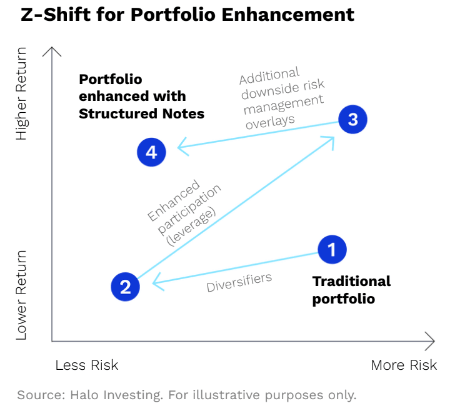
The goal of any portfolio review is to improve its efficient frontier—the sweet spot where you get the most return for the least amount of risk. Halo’s Framework facilitates what we call a “Z-Shift”. By integrating Notes, advisors can push the risk-return curve up and to the left for illustrative purposes. This is achieved through defined-outcome investing and three specific features, though all payments and protection features are subject to the credit risk of the issuer:
- Downside Protection: Using “hard” or “soft” barriers (buffers) to shield principal from the first 10%, 20%, or even 30% of market declines. If the index declines beyond these levels, the investor may lose a significant portion, or all, of their principal.
- Enhanced Participation: Utilizing Growth Notes to capture 1.5x or 2x of the market’s upside, often in exchange for a cap on maximum gains. These notes may have limited liquidity and are generally intended to be held until maturity.
- Uncorrelated Income: Generating yields that are not dependent on the Fed, the strength of the corporate bond market, or GDP growth, but rather on market volatility itself.
The Z-Shift Illustrated
Designed for Today’s Market Reality
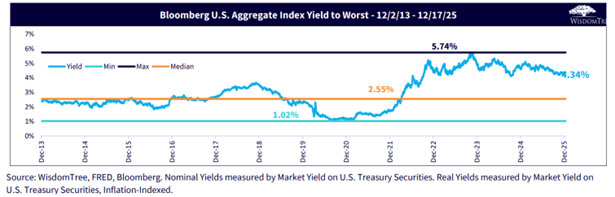
Advisors partnering with Halo are already doing this for their clients. The truth is that the market’s fat pitch may have already whizzed by. The S&P 500 has roughly doubled from its October 2022 low, while the aggregate bond index has gone from a near-6% yield to barely more than 4%. Halo’s tech-driven Asset Allocation Framework is designed to perform in the market we face today.
The US Aggregate Bond Index Yield Dips Closer to 4%
Two Ways to Implement the Framework
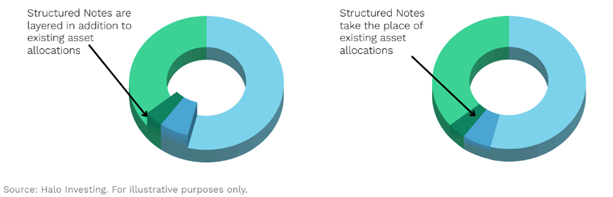
Putting the Framework into practice, our team identifies two primary methods: the Layered Approach and the Replacement Strategy.
The Layered Approach
In the Layered Approach, Structured Notes are not viewed as a substitute for a client’s current holdings but as a complementary hedge. For example, an investor might sell a portion of an S&P 500 ETF and roll those proceeds into a Structured Note linked to the S&P 500 Index. This maintains the intended equity exposure while adding a contractual layer of downside protection or enhanced yield — effectively staying in the game with a new safety net.
The Replacement Strategy
Conversely, the Replacement Strategy is a direct shift from one asset class to another. In a 2026 environment where intermediate-term interest rates are closer to 4% than 5% and money market yields potentially drop toward 3%, a client could be well-served by reallocating from their fixed income allocation to fund Notes seeking higher target yields or uncorrelated income.
Two Approaches to Better Help Clients Reach Their Goals: Layered and Replacement
A Logical & Prudent Trade-Off
With both approaches, there is a protective trade-off that simply makes sense for many people today. Giving up a bit of upside to buffer against downside risk, all while personalizing an investment strategy, works both mathematically and behaviorally.
That is the true utility of Structured Notes: they align with the advisor’s asset allocation strategy while amplifying risk management, boosting uncorrelated income, and creating defined-outcome portfolio solutions. Think of Notes as the “alternative to alternatives” for such a time as this, when stocks are richly priced and bond yields have materially dropped.
From Specialized Tool to Core Allocation
For advisors, Structured Notes are not a complex, new-age instrument. They are generally priced off indexesof stocks and bonds — asset classes that even early career wealth managers can discuss with retail investors. Moreover, we believe that Notes are on track to become a core piece of most clients’ allocations, given their ability to personalize financial plans and better manage risk.
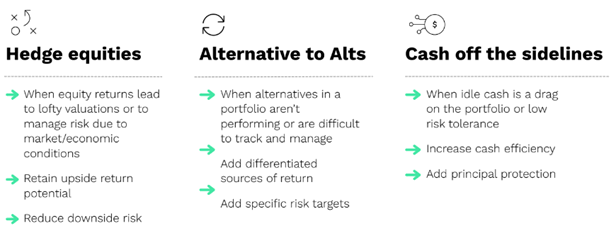
Asset Allocation Framework: Client-First Features
The Bottom Line
As 2026 begins, old allocation models face new risks. Halo’s Asset Allocation Framework helps advisors move beyond 60/40 by redefining outcomes, managing downside risk, and improving diversification — without abandoning core market exposure. In a more volatile, policy-driven market, portfolios built to protect and participate may be better positioned for what comes next.
Please see our Halo Disclosure Page for important disclosures
An investment in Structured Notes may not be suitable for all investors. These investments involve substantial risks. The appropriateness of a particular investment or strategy will depend on an investor’s individual circumstances and objectives.
Content and any tools discussed are provided for educational and informational purposes only. Halo Investing makes no investment recommendations and does not provide financial, tax, or legal advice. Any structured product or financial security discussed is for illustrative purposes only and is not intended to portray a recommendation to buy or sell a particular product or service.