
What’s Ahead:
- AI is reshaping the competitive landscape, challenging asset-light software models and forcing investors to reassess durability and disruption risk
- HALO stocks—Heavy Assets, Low Obsolescence—highlight a rotation toward tangible businesses rooted in real-world infrastructure and essential demand
- As market narratives shift, defined-outcome and protective strategies can help advisors pursue upside while intentionally managing downside risk
So long, Magnificent Seven. There’s a new thematic macro market moniker. It’s called the HALO stocks. While a fortuitous coincidence for our firm, the moniker was not the creation of the Halo Investing marketing team. We didn’t coin the term—all credit goes to Josh Brown at Ritholtz Wealth Management. “Downtown Josh” revealed HALO on his blog and during a mid-February appearance on CNBC’s Fast Money Halftime show. However, the increased visibility of the term in the public consciousness does give our firm an opportunity to discuss how our products can play a similar role in your clients’ portfolios.
But what are HALO stocks? Why has the acronym swept across Wall Street? More importantly, why should advisors and retail investors care? Let’s unpack it all.
What Are HALO Stocks?
Heavy Assets, Low Obsolescence. They are the type of stocks you may want to own if you believe AI disruption is real and happening now, according to Josh. We already see it in price action this year.
While the tech-heavy S&P 500 has traded in the same 5% range since late 2025, investors have been buying up shares of perceived “undisruptable” companies. That’s the core thesis, as AI potentially threatens the margins of asset-light software and services firms.
To level set, here’s the HALO framework:
- Heavy Assets: Companies that own massive, tangible physical infrastructure—logistics networks, warehouses, factories, energy assets, and real estate. These cannot be replicated or replaced by a large language model.
- Low Obsolescence: Businesses that provide essential goods and services that AI cannot “code away.” As Brown puts it, “No large language model is going to obviate the need for chocolate, senior living facilities, airplanes, tractors, fiber optics, and screen glass.”
The Context: AI Disrupts Software
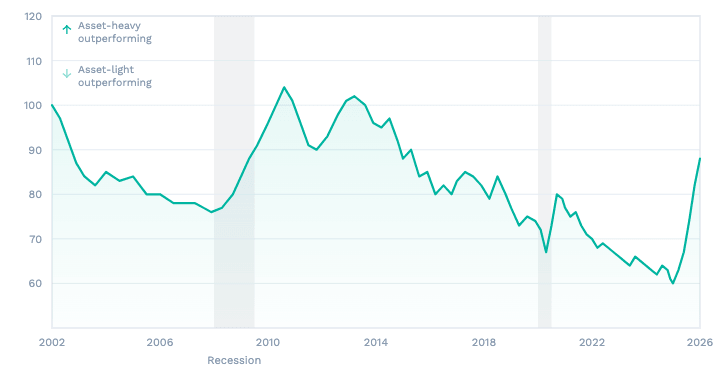
For the better part of the last decade, markets rewarded asset-light companies. Firms that could generate high annual recurring revenue—often through subscriptions and per-seat enterprise fees—boasted rising P/E multiples and soaring stock prices.
Tech platforms, digital services, and highly scalable models with low capital investment were the darlings. A 2022 bear market notwithstanding, software was eating the world in the pandemic’s wake—until AI hit its stride.
Reversal in Asset-Light vs. Asset-Heavy Stocks
Source: Goldman Sachs
Indeed, as artificial intelligence tools proliferated across the corporate world, investors grew concerned about the risk of disruption. And this isn’t a history lesson—it’s happening now. As recently as the summer of 2025, the iShares Expanded Tech & Software ETF (IGV) posted tremendous alpha, albeit with occasional sharp corrections. But losses in the last few quarters have been more than just a radar blip—they have been bludgeoning.
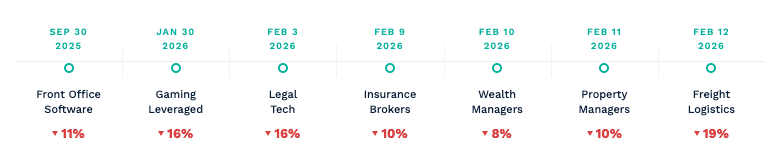
The “SaaSpocalypse” coincided with a 35% plunge in IGV. The ETF topped last September, before the S&P 500 reached the high end of its recent range. Worrisome ripples in the tech space and concerning cockroaches elsewhere further pressured IGV. The major selling cascade occurred in January, when Anthropic introduced several Claude AI add-ons aimed at specific industries.
Niches from software to legal to insurance to wealth management—even trucking—were in AI’s crosshairs. Then, in February, a viral post from a little-known firm called Citrini Research further shed light on what could become a dystopian economic future.
AI-Sparked Sector Sell-Offs by Group Stock Performance
Source: CNBC, Jefferies
Why HALO Matters Now
Here are the big questions investors and corporate executives face:
- What happens to a platform whose value lies in its software stack when that same functionality becomes commoditized by AI?
- What happens to the premium markets once placed on perpetual growth when technology itself becomes a threat to margins?
- What sectors, geographies, styles, and factors are at risk, and which are primed to lead?
Enter HALO—the thematic rotation toward companies whose value is tied to the JM real world and essential economic functions. You know many of these stocks: ExxonMobil (XOM), Caterpillar (CAT), FedEx (FDX), Walmart (WMT), Starbucks (SBUX), and Delta Air Lines (DAL), just to name a handful.
These firms with physical assets are simply unlikely to be rendered obsolete by AI. More broadly, the quick turn toward capital-intensive, “real economy” blue chips—and away from SaaS stocks—reminds investors that narratives can change abruptly.
At Halo Investing, protection is more than just downside defense against the next thematic 180. We are about helping advisors prepare their clients for a broad range of market and personal financial outcomes.
HALO Stocks Meet Halo Investing
Just as Josh’s HALO playbook may keep equity portfolios in the game, Halo Investing’s defined-outcome strategies seek to limit unnecessary losses while still offering meaningful upside participation. What’s more, yield products are as popular as ever, and Structured Notes issued through our award-winning platform continue delivering value for income investors.
Important considerations: Structured notes are subject to the credit risk of the issuing financial institution—if the issuer defaults, investors may lose some or all of their principal regardless of the performance of the underlying asset. Additionally, structured notes typically offer limited upside participation, meaning investors may not fully capture gains in a strongly rising market. These characteristics should be carefully weighed against client risk tolerance and investment objectives.
True protective investing complements a worldview in which uncertainty is permanent, not temporary. Growth Notes and Income Notes can be tailored to each client’s unique risk and return objectives, potentially generating returns separate from prevailing macro trends while producing uncorrelated income during bull and bear markets. Furthermore, Halo’s Advanced Wealth Solutions offer additional strategies and services to meet a full range of client financial goals.
Practical Implications for Advisors
HALO stocks, geopolitical risks, investor anxiety, and a rising cost of living—what’s the strategy? Here are actionable insights:
- Diversification must go beyond traditional asset classes. A simple allocation by sector or style ignores AI disruption risk. We are not making a bold call either way on AI’s long-term market impact. But the HALO equity framework should, at the very least, prompt investors to weight asset durability and obsolescence risk explicitly.
- Protection is an active choice, not a default. Too many investors expose themselves to macro-correlated risks, largely due to inertia. We see it in the 60/40 portfolio. While the global 60/40 performed well in the latest run-up, we regularly see that stocks and bonds often plunge together when volatility strikes. Durable protective investment strategies offer uncorrelated upside and are tailored to client objectives.
- Communication is critical. Themes like HALO go viral because they are intuitive. Owning shares of tangible businesses with real assets feels safer in an era of rapid AI innovation. The same goes for Structured Notes and protective investing—it makes sense to include something other than stocks and bonds to pursue long-term goals. Getting the message across to clients matters.
- Rebalance smartly. Returning a portfolio to its intended weights is always prudent. In today’s environment—after a strong rally off last year’s lows—putting new cash to work in differentiated performance vehicles (like Notes) could be an ideal tactic. Think of it like putting liquidity to work without liquidation.
Looking Forward: Protection in a New Era
Markets appear to be pricing in durability, not just future growth. We can take that macro reality and frame it against clients’ investment strategies. Just as relying on once high-flying tech stocks turned out to be riskier than previously thought, leaning on a “balanced” 60/40 index fund ignores risks that may lie ahead. Additional tools and battle-tested protective investment solutions are required.
What is the new era? We don’t know. Neither does anyone else. And that’s the point. Holistic diversification—including uncorrelated income and differentiated risk-return exposure within existing allocations—serves as a better all-around defense.
The Bottom Line
Josh Brown was onto something when he conceived the HALO stocks. Asset-heavy companies that can benefit from AI (and not be replaced by it) are back in vogue. Some saw the paradigm shift coming; others were caught flat-footed. That doesn’t matter much.What’s important for advisors and their clients today is that they remain open to new risks, emerging disruptions, and better investment solutions. The HALO framework is the equity-level version of that idea, while Halo Investing’s defined-outcome strategies are the personal portfolio-level version of that idea.
Please see our Halo Disclosure Page for important disclosures
An investment in Structured Notes may not be suitable for all investors. These investments involve substantial risks. The appropriateness of a particular investment or strategy will depend on an investor’s individual circumstances and objectives.
Content and any tools discussed are provided for educational and information purposes only. Halo Investing makes no investment recommendations and does not provide financial, tax, or legal advice. Any structured product or financial security discussed is for illustrative purposes only and are not intended to portray a recommendation to buy or sell a particular product or service.