What’s Ahead:
- Poor risk management at SVB Financial Group ended in the largest bank failure since 2008.
- Fears of systemic problems led regulators to craft a backstop so that SVB depositors could be made whole and that other regional banks would not face runs.
- Volatility likely continues in the months ahead, but a 2008-like outcome is a low-probability event in our view.
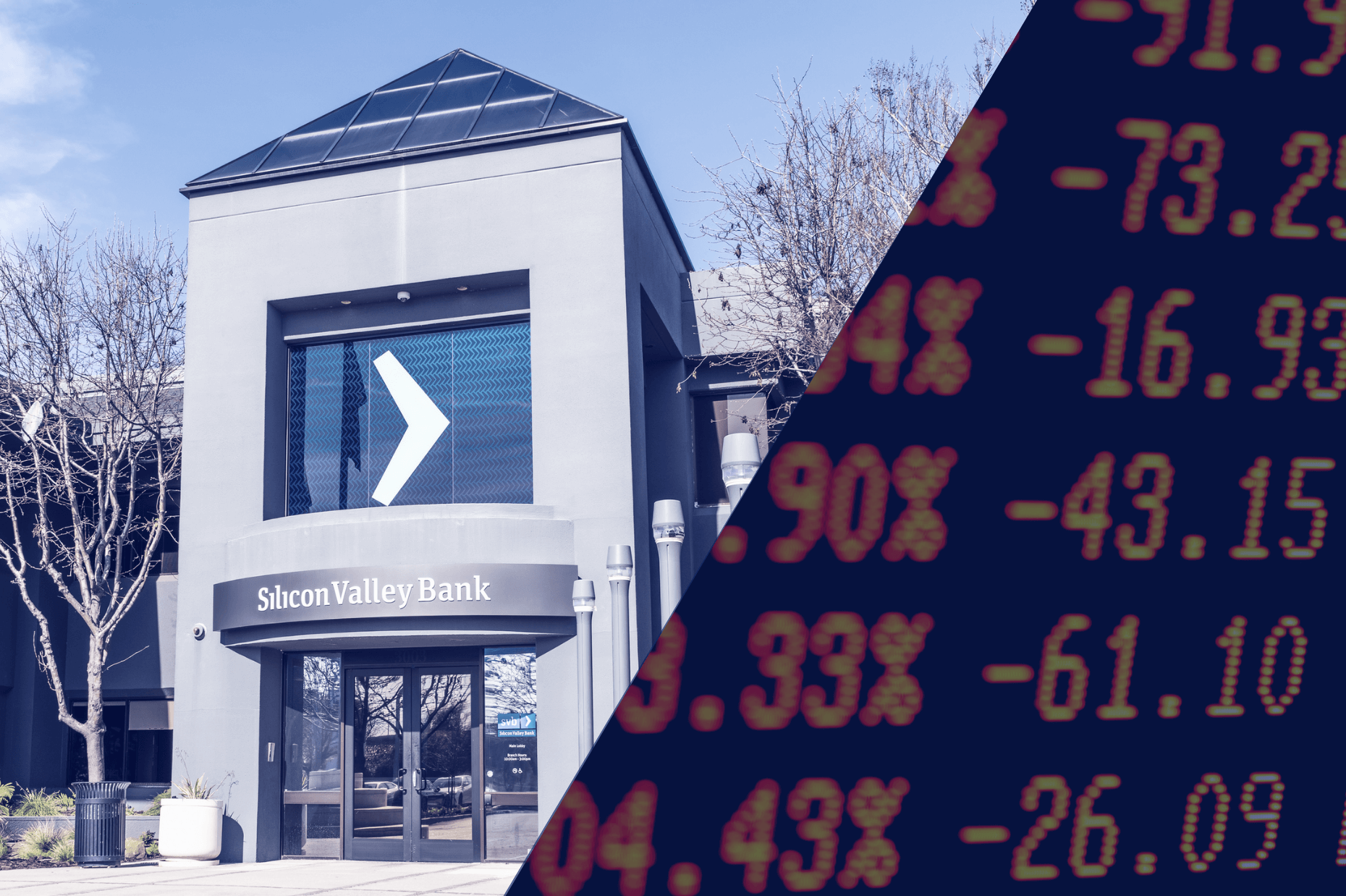
Fears of a repeat of 2008 quickly arose as the failure of Silicon Valley Bank, also known as SVB Financial (SIVB), unfolded earlier this month. Over just 48 hours the California-based financial institution went from being America’s 16th largest bank to closing its doors. How it all happened is now a perilous story for the history books and one that risk managers and investors alike will study for decades to come.
Right now, though, there are still question marks as to how the banking industry and Financials sector will emerge from the SVB saga. Are there more shoes to drop? Did regulators do enough to protect against systemic risks? Did they do too much? Is this the start of another 2008 Great Financial Crisis (GFC)? These are all questions we cannot fully answer yet. However, one thing is certain — protecting yourself from volatility remains a key strategy.
Key Factors Causing the SVB Bank Run
Taking a step back, many people are wondering how this all happened and why SVB unraveled so quickly. Let’s first identify the causes. This was a classic run on a bank. Depositors all at once demanded a return of their cash following a failed equity-raise attempt by SVB and calls that the tech-focused bank would not be able to meet all its financial obligations.
At the same time, SVB’s balance sheet was in worse condition than many Wall Street analysts realized. Its portfolio of assets had declined in value due to the steep rise in market interest rates over the past 18 months. After the bursting of the tech, venture capital (VC) and private equity (PE) bubbles in late 2021, SVB’s primary customer base was also not exactly thriving. Putting all that together, SVB Financial’s stock price plunged from a late-2021-high near $350, to $0 today.
Steepest Rate Rise in Decades
Change in Fed Funds Rate
In Months Since Hiking Cycle Started

Halo’s Risk Management Process
At Halo, we are focused on risk management so that financial advisors and investors can have the utmost confidence that our investments are issued by strong financial institutions. None of our structured notes have gone through SVB, and our team constantly performs due diligence to ensure that our protective investment solutions are as safe as possible. Volatility will continue and more problems will inevitably arise, but the macro conditions in 2023 are very different from those seen during the broad-based economic calamity 15 years ago. What’s more, regulations put in place in the years after 2008 should help buffer against long-lasting banking turmoil.
Is This 2008 All Over Again? We Don’t Think So.
Recency bias is a powerful thing in markets. It drives fear and greed. Immediately after the Federal Reserve, Treasury Department, and FDIC gathered on the weekend of March 12 and announced a new backstop facility called the Bank Term Funding Program (BTFP), memories of Bear Stearns and Lehman Brothers were instantly rekindled. But this is not 2008. What happened at SVB was a perfect storm of factors of that now-failed institution. But shortly after SVB was put into survivorship by regulators, Signature Bank (SBNY) of New York was forced to shutter and solvency fears with embattled Credit Suisse (CS) have grown — additional examples of how fear can cascade swiftly in the banking world.
Looking closer at the new federal program, the BTFP protects depositors and essentially guarantees that some bank holdings can be valued at par so that losses do not have to be recognized on the income statements of banks. Some pundits claim that this is akin to yet another bank bailout program. That’s arguable, but the BTFP is meant to protect depositors while allowing SVB’s stock and bond holders to lose everything. Under the programput in place by a consortium of regulators, savers’ deposits are indemnified beyond the current $250,000 FDIC insurance limit.
SVB Served High-Risk Technology Companies
What’s different about SVB is that the majority of its customer base was high-risk technology VC and PE companies, not individuals or even small businesses from other industries. The bank chose to focus on one highly volatile segment of the business world in its region. That meant that its depositors had account sizes in the millions, not thousands, the vast majority (88%) of which were uninsured . SBNY was the other outlier with 90% of uninsured deposit balances as of the end of 2022.
The Timeline of Events Leading to the Silicon Valley Bank Failure
The string of events that led to SVB’s demise started with the COVID-19 pandemic three years ago. Policymakers acted fast to stimulate the economy by slashing interest rates and issuing stimulus payments one after another. That ample liquidity injection drove investments in many risky areas of the economy — PE and VC startups being some of the primary recipients. These newly formed companies needed a bank, and SVB aimed to be the go-to financial institution for so many Silicon Valley startups. The bank’s filings show that quarterly VC investment dollars more than doubled from 2020 to the end of 2021. By year-end 2022, total assets on SVB’s balance sheet were $209 billion, but by the first quarter of 2023, VC investment activity had ground nearly to a halt.
SVB: One of America’s Largest Banks by Year-End 2022

Perhaps no bank benefited more from the tech-led boom during and after the pandemic than SVB. FactSet notes that from the end of 2020 through just the first quarter of 2021, total deposits rose by 94%, much of that inflow coming from the VC space. Those deposits were largely in excess of the FDIC insurance limit. As banks do, they lent out money to other technology companies or invested in longer duration assets to earn interest. As soon as rates began to increase and the tech boom slowed, the bank’s solvency quickly eroded.
Rising Interest Rates, Not Loan Defaults, Were the Problem
In 2020 and 2021, SVB simply bought Treasuries and mortgage-backed securities (MBS) at low rates. The risk with that is not that defaults would lead to losses on the books, but that rising interest rates would create unrealized losses that would only have to be marked should the bank sell those fixed-income products. So long as a bank’s operations run smoothly, there is no need to sell before a bond’s maturity, so large unrealized losses on SVB’s balance sheet went largely unnoticed by its risk team and other analysts.
SVB, like all banks, has assets treated as “held to maturity” (HTM) and “available for sale” (AFS) along with “trading securities”. Gains and losses on HTM and AFS assets, unlike trading securities, are only taken to the income statement when they are sold. Once again, during normal times that’s no big deal, but when depositors demand a return of their money all at once, those assets must be sold to meet liquidity needs. As a result, major losses would be reported. SVB could not withstand that kind of pressure. So, the regulators came together to allow some HTM assets to be valued at par so that all depositors could be repaid.
Accounting Models for Debt Securities: HTM Losses not Recognized Until Assets Are Sold

The Outlier? SVB’s Dire Capital Ratio, Factoring in Unrealized Bond Losses
Impact of Unrealized Losses on Capital Ratios
Percent (%)

Breaking it down further, Silicon Valley Bank did a poor job of matching its assets with its liabilities. In accounting parlance, it is known as ALM, or asset-liability management. Mitigating potential problems from fluctuations in interest rates is a fundamental risk management practice for banks, and SVB failed miserably at it. Moreover, the bank didn’t even have an active Chief Risk Officer for much of 2022. It’s another case of awful corporate governance and excessive risk taking. This was not like 2008 in that there was no investing in esoteric assets — it was simply a failure to ensure that the liability side of the bank’s ledger was protected enough by the asset side.
A Failed Capital Raise Began the Unraveling
All of this came to light earlier this month when SVB attempted to raise equity capital to help offset losses from the sale of its AFS portfolio. Its stock price plummeted shortly after the failed capital offering and financial markets reacted harshly. The selling cascaded from SVB to other regional banks and the broader Financials sector on Thursday, March 9, and Friday, March 10. SVB depositors’ withdrawals totaled a whopping $42 billion on March 9 alone. By the weekend, the media captured images of people standing in lines at banks to request withdrawals.
So, what caused SVB to unravel? We can trace it back to all the stimulus thrown at the economy in 2020 and 2021 driving excessive speculation. That fueled profits for SVB and its PE and VC customer base. As the bank’s share price ballooned, SVB’s management team likely thought it could do no wrong. It was a game of musical chairs, however, and once the music stopped, SVB’s lack of proper risk management quickly became known following the early March failed capital raise. A run on the bank within 48 hours ended with the largest bank failure since the GFC, and confidence in the entire financial system was shaken.
The Bottom Line
At Halo, we believe the economic foundation today is better than it was in 2008. We are cautiously optimistic that this event will prove to be contained to just the riskiest regional banks, while large, established financial firms may actually benefit from increased deposits. But we also expect volatility to persist as markets continue to combat broad macro risks. Investors should remain focused on reaching their goals, and defined-outcome protective investment strategies help them do just that.
Please see our other important disclosures.