
Intro to Structured Notes
Gain a better understanding of structured investments with an overview of key concepts. Go deeper with this getting started series.
–

What are Structured Notes?
Structured Notes are an investment product, typically issued by a bank, designed to offer an investor market linked growth potential and safety features similar to bonds.
Notes provide investors with the potential to achieve growth and/or income with different levels of principal protection to match their tolerance for risk. The performance of a Note can be linked to markets such as equities, commodities, and interest rates.
Understanding Structured Notes
01
Finally, a level of protection without sacrificing potential upside capture

Source: Halo Investing and AllianceBernstein (AB). For illustrative purposes only. There is no guarantee that these objectives will be met. Diversification does not insure against risk of loss. For complete methodology description, please see https://www.alliancebernstein.com/library/portfolio-risk-management-a-multidimensional-perspective.htm
02
Structured Notes may be a reliable and cost effective hedge

Source: Halo Investing and AllianceBernstein (AB). For illustrative purposes only. There is no guarantee that these objectives will be met. Diversification does not insure against risk of loss. For complete methodology description, please see https://www.alliancebernstein.com/library/portfolio-risk-management-a-multidimensional-perspective.htm
03
Seeking better potential outcomes through volatility management

Source: Halo Investing. For illustrative purposes only. This illustration does not take into consideration a client’s specific investment objectives, risk tolerance, or financial situation.
Understanding Structured Notes
01
Finally, a level of protection without sacrificing potential upside capture

Source: Halo Investing and AllianceBernstein (AB). For illustrative purposes only. There is no guarantee that these objectives will be met. Diversification does not insure against risk of loss. For complete methodology description, please see https://www.alliancebernstein.com/library/portfolio-risk-management-a-multidimensional-perspective.htm
02
Structured Notes may be a reliable and cost effective hedge

Source: Halo Investing and AllianceBernstein (AB). For illustrative purposes only. There is no guarantee that these objectives will be met. Diversification does not insure against risk of loss. For complete methodology description, please see https://www.alliancebernstein.com/library/portfolio-risk-management-a-multidimensional-perspective.htm
03
Seeking better potential outcomes through volatility management

Source: Halo Investing. For illustrative purposes only. This illustration does not take into consideration a client’s specific investment objectives, risk tolerance, or financial situation.
Getting started with Structured Notes
Today’s Structured Note market is transparent, competitive, and highly efficient. Halo Co-Founder and President, Jason Barsema, discusses how getting started with Structured Notes is no more challenging than approaches using conventional stocks & bonds.
We cover:
- The growing market for Structured Notes.
- How Structured Notes work.
- Investor and client benefits of Structured Notes.
- How Structured Notes can be used to meet a variety of investment and financial planning challenges.
Source: Halo Investing. For illustrative purposes only. This illustration does not take into consideration a client’s specific investment objectives, risk tolerance, or financial situation.
How notes fit in a portfolio
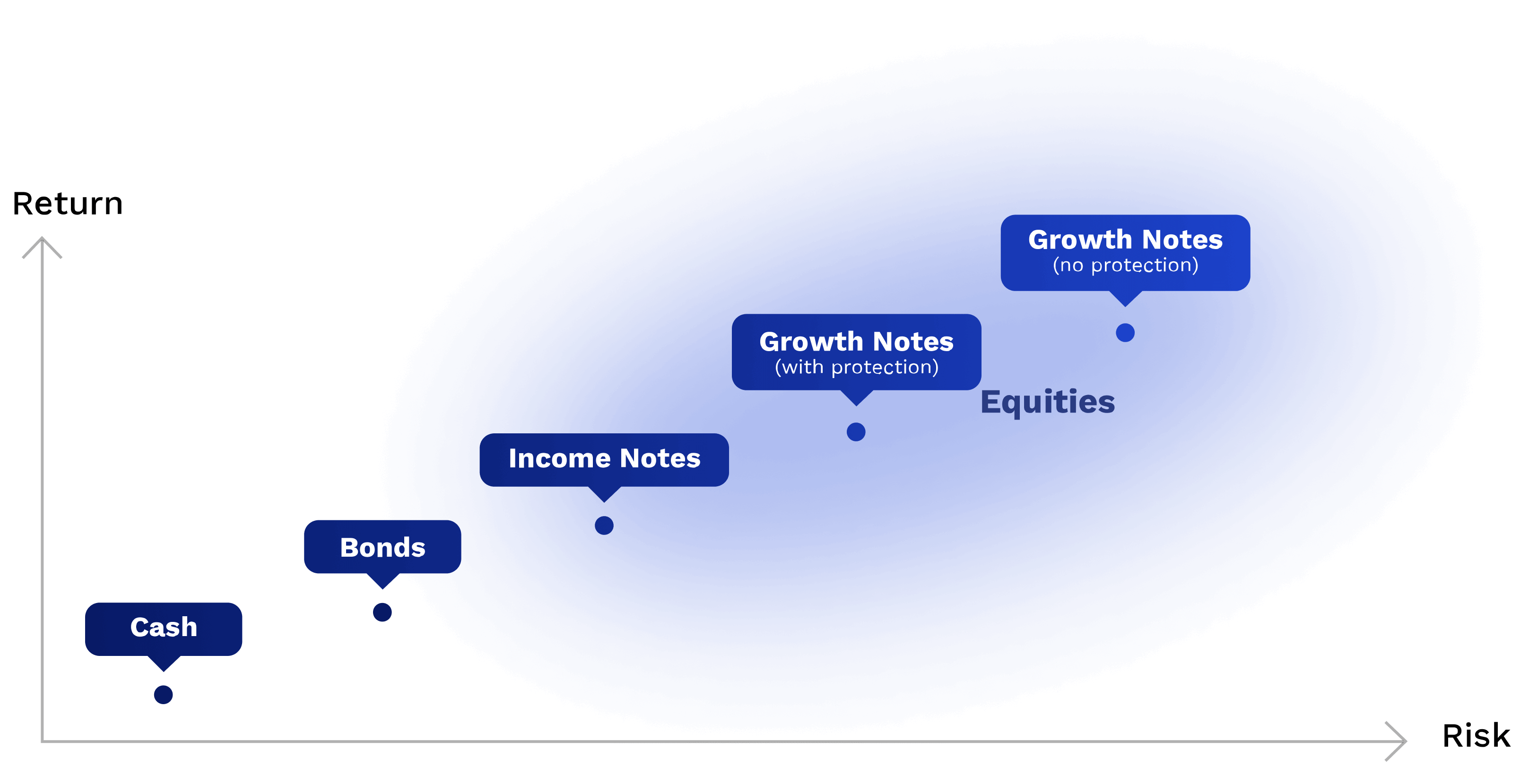
As investing’s Swiss Army knife, notes can be used to add risk, remove risk, or create a variety of different risk-reward scenarios. In this sense, notes can help bridge the gap between stocks and bonds.
When linked to an equity index, Growth Notes target an enhanced upside participation. This is equivalent to a strategy seeking capital appreciation.
For income conscious investors, Income Notes have the potential to pay above-average yields, when compared to equivalent fixed-income opportunities.
Structured Notes offer opportunities for adding a level of downside protection. This built-in protection is a defining feature of Structured Notes. This can help eliminate the need to find uncorrelated assets, appropriate hedges, or whatever other approach you’re currently using to mitigate market risk.
Source: Halo Investing. For illustrative purposes only. This illustration does not take into consideration a client’s specific investment objectives, risk tolerance, or financial situation.
Making the most of Halo and Structured Notes
Learn how Halo’s award-winning platform is helping advisors and wealth managers access a class of investments we call “protective investments.” Beyond access, Halo’s platform features education, risk management tools, and a technology suite that often integrates nicely with existing systems. Pre-and post-trade capabilities ease the administrative burden often associated with Structured Notes; Halo’s multi-issuer platform promotes competitive pricing and transparency. Here’s how.
Structured Notes have complex features and may not be suitable for all investors. They are sold only by prospectus and investors should read the prospectus and pricing supplement carefully before investing as they contain a detailed explanation of the risks, tax treatment, and other relevant information about the investment. The tax treatment of Structured Notes varies depending on the offering, and can be uncertain in some cases. Structured products are sold through financial professionals, and investors should consult accounting, legal, and/or tax professional before investing.
Getting Comfortable with Structured Notes
Structured Products
Structured Products come in all shapes and sizes. This brief introduction is a good place to start.
Income Notes
Income Notes are best known for their ability to produce investment income.
Growth Notes
Growth Notes can be a good way to participate in potential market gains, but add a level of downside protection.
Digital Notes
Digital Notes (or Step Payment) are similar to an Income Note, but pay one coupon payment at the maturity.
Soft Protection
Soft Protection only provides protection up to a certain level of losses. It is a more aggressive protection form.
Hard Protection
Hard Protection absorbs a percentage of negative performance. It is considered a more conservative form of protection.
Autocall
Structured Notes may be autocallable. Meaning, they could be retired prior to their stated maturity.
Contingent Coupon
Some Income Notes may feature contingent coupons. It’s important to understand how they work.
Worst-Of
“Worst-Of” baskets are a common way to add exposure to several underliers.
Max Return
Some Growth Notes may include a max or capped return.
US76/1.0/2306