
What’s Ahead:
- Volatility causes bad investor behavior such as trying to time the market.
- Building long-term wealth requires discipline and the right portfolio strategies to help avoid mistakes.
- Halo Investing’s protective investments help everyday investors stick with a plan so they can hit their financial goals.
It’s easy to get caught up in the near-term volatility of the stock market. Investing is a breeze when the trend is up and you see your account value climb as the S&P 500 notches all-time highs day after day. It’s when bear markets and recessions hit that investor mettle is tested. Toss in high inflation and rising interest rates, and even bond investments can look questionable.
In moments like these, sticking with a disciplined long-term strategy is crucial to building and maintaining wealth. So what can you do when everyone around you is losing their cool?
Remember, Time is on Your Side
Consider that Warren Buffett made about 95% of his total wealth after the age of 60. When most workers call it quits, he was essentially just getting started earning one billion after another. Are you the next Oracle of Omaha? Ahh, probably not. We certainly are not. But that doesn’t mean we can’t take a like-minded approach to Warren. At the end of the day—or week—what matters is staying invested and taking advantage of your biggest asset of all: time.
Don’t Miss Out
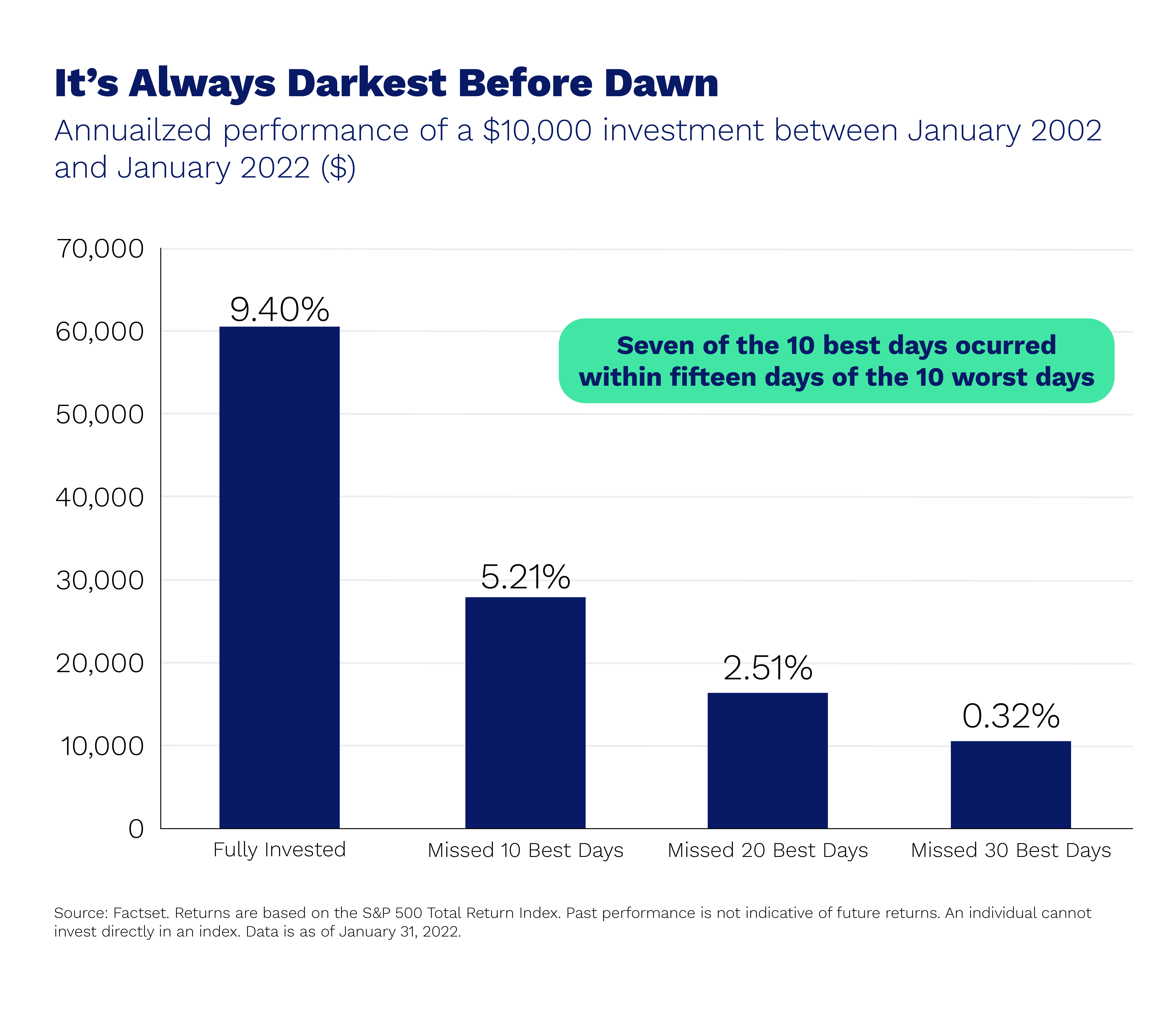
Among the favorite charts of financial advisors is one from J.P. Morgan Asset Management that illustrates the importance of staying invested when volatility arises. It’s commonly known that market timing is like a land mine on the road to retirement. According to historical data, over the previous two decades, the S&P 500 has returned 9.4% on average each year. That is a solid return. If you tried to swoop in and out and missed the 10 best days, however, your net return would have been just 5.21%. Missing the 20 best days would have left you with a return that barely beat inflation.
Saying it’s hard—if not impossible—to time the market is not just another investment cliche. Few have ever done it right. And we think there’s a better approach to guessing the next turn.
The Perils of Timing the Market
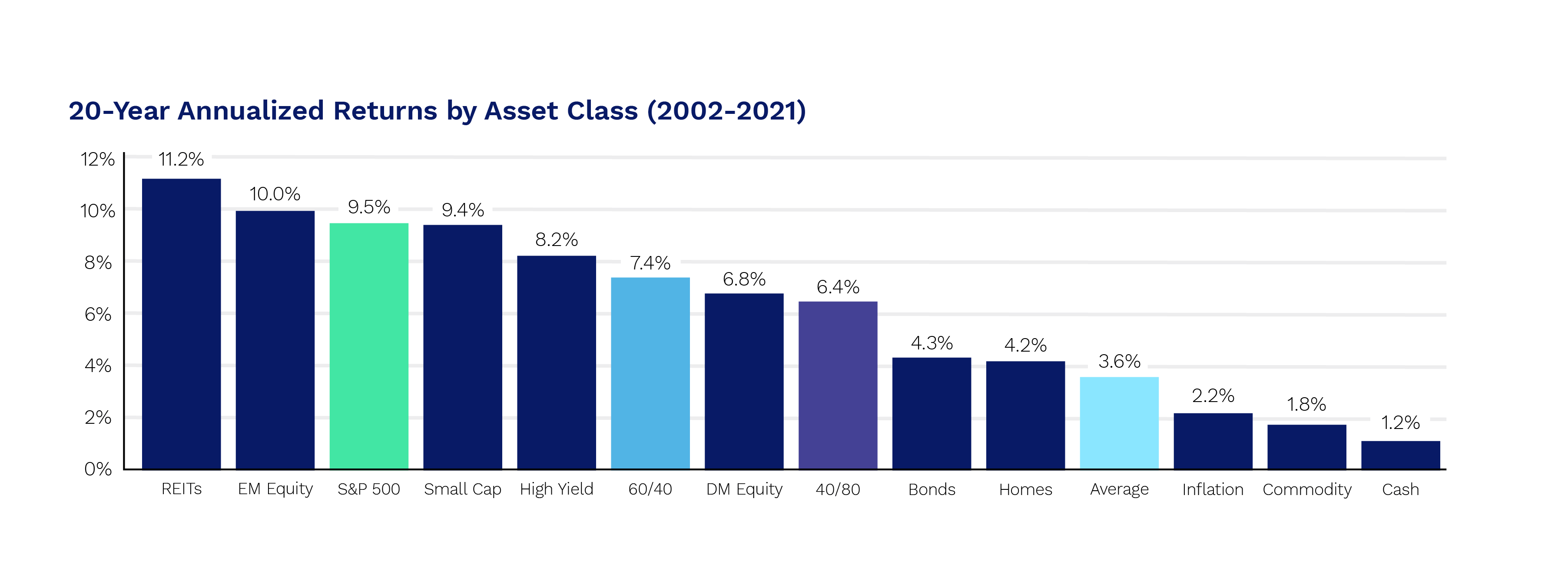
The stock market and low-cost index funds can work wonders to help everybody amass long-term wealth. But we can be our own worst enemy. There’s a popular study by DALBAR that aims to quantify how investors hurt themselves when trying to time the market. While controversial, the results show that the average investor’s return from 2002 through 2021 was 3.6% compared to 9.5% for the S&P 500 and 7.4% for a traditional 60/40 stock/bond portfolio. Dubbed “the behavior gap,” it can be thought of as the price people pay for attempting to beat the market. Other studies show a smaller gap, but there’s little doubt that market timers generally underperform an index.
The Behavior Gap
But why do investors behave this way? Isn’t there enough evidence that attempting to outperform the broad market is often a foolish endeavor? To help explain this, we follow the science, which shows we have natural biases. People hate losing more than they like winning. Behavioral economics and the concept of “loss aversion” teaches us that we as humans feel the pain of losing about twice as much as the joy of winning.
Adding Up the Pain
Applying this concept to financial markets, when tough years (like 2022) come about, checking your portfolio value daily results in either a positive dopamine hit on an up day or a psychological gut punch on a down day. The more you check, the more negative you feel if half the days show red on your portfolio position page, all thanks to loss aversion. Soon enough, investors might just throw in the towel and go to cash. And that is what causes the behavior gap and missing out on the market’s biggest rallies.
How Protective Investments Help
So what’s the solution? A portfolio that works best for you in the real world, not one that’s simply the ‘optimal’ solution on a spreadsheet is a good place to start. Protective investments and defined-outcome strategies can help prevent investors from losing their cool when markets jump out of line. Participating in the market’s upside while having some downside protection helps folks weather the periodic storms that invariably arise.
Halo’s Three Protective Investment Solutions
Protective investments, offered through Halo, come in a variety of flavors. Structured notes use bonds and options to tailor an investment product designed to have a larger dividend yield along with limited losses under certain market scenarios. Annuities on our platform can lock in an income stream to protect against longevity or sequence risk or even to help reach a near-term financial goal. Finally, buffered ETFs create defined-outcome strategies so investors can have some security around a portfolio’s ending value.
The Bottom Line
Halo Investing believes in impact before profits. We want people to stay invested through the thick and thin. We also recognize that what works best on a spreadsheet is not always the best portfolio for a specific investor. Working with an experienced advisor and owning assets that help people stick with a long-term investment strategy are critical to achieving financial goals.
Halo Investing believes in impact before profits. We want people to stay invested through the thick and thin. We also recognize that what works best on a spreadsheet is not always the best portfolio for a specific investor. Working with an experienced advisor and owning assets that help people stick with a long-term investment strategy are critical to achieving financial goals.
Please see our Halo Disclosure Page for important disclosures.