
What’s Ahead:
- Election year investing naturally puts investors on edge.
- In reality, who wins the presidency has had little impact on actual market performance.
- This guide shows why and offers some suggested steps to use Structured Notes, just in case you want an extra level of protection.
The presidential election will be one of this year’s biggest stories. Voters will get their say in November, but with a long-term focus, investors can position themselves for a brighter future regardless of the outcome. In fact, overreacting to sensational headlines and short-term volatility during election cycles can be detrimental to investment returns.
In this brief guide, we tackle some of the most common election year questions, drawing insights from over 90 years of investment data across 23 election cycles. This guide can help keep things in perspective for what can be an otherwise stressful market environment.
In reality, since the days of George Washington, the party in office has made little difference to the performance of stock markets during their tenure.
Key Takeaways
1. U.S. stocks have traded up whether a Republican or Democrat wins the presidency.
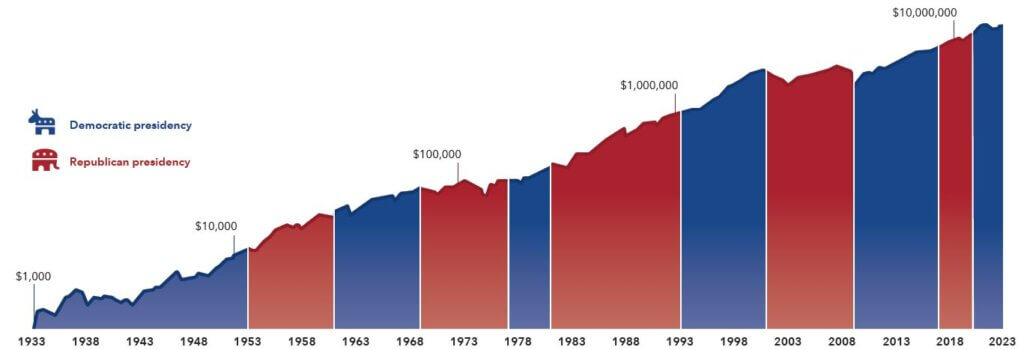
A $1,000 investment in the S&P 500 Index made when FDR became president in 1933 would have been worth more than $19 million in 2023. During that time there have been seven Republican and eight Democrat presidents.*
2. Sitting on the sidelines doesn’t help. Time matters, not timing.
The S&P 500 Index had negative returns in only two of the last 20 election years (2000, 2008), and in both of these examples, retreats were largely the result of asset bubbles, not politics.*
3. Structured Notes can add a level of downside protection while retaining growth and income opportunities.
Growing wealth while protecting it often involves a set of hard trade-offs. Structured Notes may offer an interesting reward-to-protection level unavailable in similar investment techniques.
* Capital Group, Guide to Investing in an Election Year, 2023 edition.
Which political party has benefited investors the most?
Actually, party matters far less than you might think.
Investing during an election year can be tough on the nerves, and 2024 promises to be no different. Indeed, politics can elicit strong emotions and biases, but investors would be wise to tune out the noise and focus on the long term. That’s because elections have, historically speaking, made essentially no difference when it comes to long-term investment returns.
What should matter more to investors is staying invested. A $1,000 investment in the S&P 500 made when Franklin D. Roosevelt took office would have been worth more than $19 million as of June 30, 2023. During this time there have been eight Democratic and seven Republican presidents.
Putting money in motion during an election year is never easy, and this year should be no different. While politics can bring out strong emotions—and biases—it’s always prudent for investors to remain rational and focus on their long-term goals.
Why? Because historically, elections have made no difference to long-term investment results.
Staying invested for the long haul has simply paid off. A $1,000 investment in the S&P 500 made when Franklin D. Roosevelt took office would have been worth over $19 million as of June 30, 2023. During this time there have been eight Democratic and seven Republican presidents.
Markets have been far more resilient than investors. Those that can stay the course and rely on time in the market, rather than timing the market, have been rewarded handsomely.
Growth of a hypothetical $1,000 investment in S&P 500 Index
Okay, so what’s the best way to invest?
Staying on the sidelines has rarely paid off. Time in the market, not timing the market, is what matters most.
Despite election year headlines, investors rarely benefit from moving out of the stock market based on election results or policy changes.
Using three hypothetical investors, Capital Group offers a helpful exercise. For three different investment approaches, they found the ending value for each of their portfolios over the last 22 election cycles. This assumes a four-year holding period.
The investor who stayed on the sidelines had the worst outcome 16 times and only had the best outcome three times. Meanwhile, investors that were fully invested or made monthly contributions to a 401(k), for example, during election years came out on top. These investors had higher average portfolio balances over the full period and more frequently outpaced the investor who stayed in cash longer.
Long story short, time in the market matters, not timing the market’s ups and downs.
Three hypothetical $10K investment strategies during an election cycle
Analysis of 22 election cycles since 1932
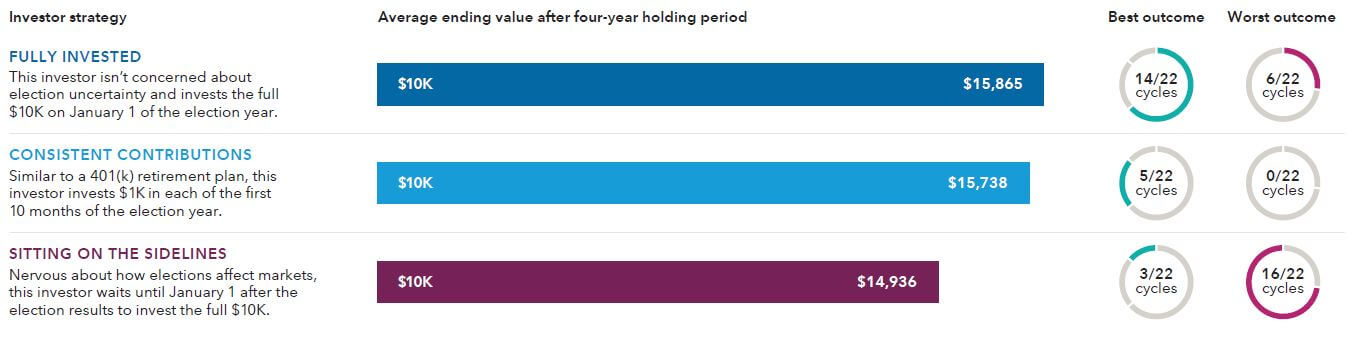
Sources: Capital Group, Guide to Investing in an Election Year, 2023 edition. Board of Governors of the Federal Reserve System (US), RIMES, Standard & Poor’s. The three hypothetical investors each have $10K to invest during an election cycle and are invested in a combination of equities and cash at all times. fully invested is always fully invested in equities. consistent contributions starts with $1K in equity and $9K in cash. At the start of each of the next nine months, this investor reduces cash by $1K and makes a $1K contribution to equities, after which they will have made the full $10K contribution to equities. sitting on the sidelines is entirely invested in cash during the first year. At the start of the second year, this investor reduces cash by $10K and makes a $10K contribution to equities. S&P 500 Index used for equity returns, and returns reflect the reinvestment of dividends. 3-month Treasury Bills used as a proxy for cash returns, and returns reflect the reinvestment of interest. Returns and portfolio values are calculated monthly and in USD. Analysis starts on January 1 of each election year and reflects a four-year holding period. 2020 election is not included since there has not been a full four-year holding period to analyze, as of June 30, 2023. Past results are not predictive of results in future periods.
Structured Notes for an added level of protection
When in doubt, Structured Notes might be just the insurance your clients want.
The basic approach to portfolio construction has changed little over the past few decades. Equities provide returns for accepting risk; bonds are used for protection. This simplified approach, illustrated by the ‘60/40 stock-bond’ portfolio, has worked well for many years. However more recently, investors have seen the risk management afforded by traditional asset allocation techniques challenged numerous times.
Increasingly, advisors are turning to Structured Notes to help keep clients fully invested by adding an extra level of downside protection. Numerous Structured Notes are now available that can be tailored to a variety of client investment objectives. The flexibility available in structured products can be particularly helpful in stressful environments such as an election year.
Growing wealth while protecting it often involves a set of hard trade-offs. Traditionally, the assets with the highest potential reward were also the hardest to shelter from loss.
Technology and access are changing things. Today, with Structured Notes, investors of all walks can add downside risk mitigation without giving away upside capture potential.
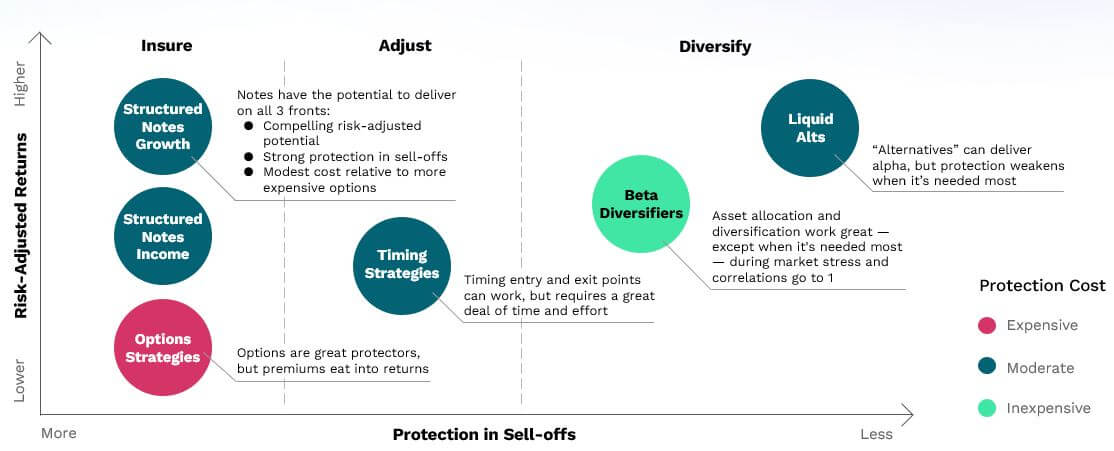
When held to maturity, Structured Notes can present an interesting reward-to-protection trade-off relative to other strategies like timing the market or “diversifying” with exotic investment vehicles. To learn more, check out our primer on getting started with Structured Notes.
Visualizing the 3 dimensions of risk management – risk, reward, and the cost of protection
An investment in Structured Notes may not be suitable for all investors. These investments involve substantial risks. The appropriateness of a particular investment or strategy will depend on an investor’s individual circumstances and objectives.
Please see our Halo Disclosure Page for important disclosures.
US188/1.0/2401